
Interest in testosterone has surged in recent years, driven by a mix of medical, cultural, and commercial influences. As awareness of age-related hormone changes grows, more people—particularly men—are turning to testosterone as a potential remedy for symptoms like fatigue, low libido, and reduced muscle mass.
While testosterone therapy is FDA-approved for treating clinically diagnosed deficiencies, its use for age-related declines remains off-label. Even so, demand continues to grow, reflected in rising prescriptions and a booming market of over-the-counter supplements, wellness clinics, and online platforms promoting treatment for what’s commonly known as “low T.”
To better understand how this interest is evolving, Invigor Medical—a telehealth company focused on the wellness space—analyzed search data from Google Trends to identify patterns in public curiosity about testosterone. The analysis examines how rapidly search interest is growing, the specific questions and concerns Americans are most frequently researching, and which states are leading the surge in online interest. Additionally, the report explores how political affiliation might influence testosterone-related search behavior.
Table of Contents
How Fast Is Interest in Testosterone Growing?
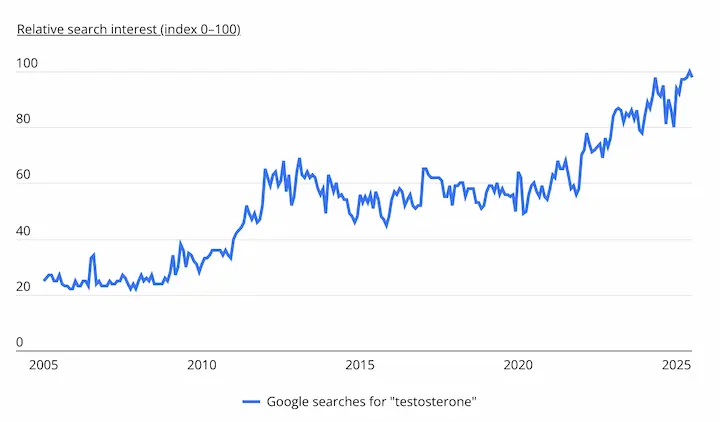
Public interest in testosterone surged in the early 2010s, with Google search volume peaking in early 2013. This period aligned with a sharp rise in prescriptions and growing awareness of low testosterone among middle-aged men, fueled by direct-to-consumer advertising and the expansion of hormone clinics. A 2013 Journal of the American Medical Association study found that testosterone use in the U.S. tripled between 2001 and 2011.
Interest declined in 2014, coinciding with an FDA warning about potential cardiovascular risks linked to testosterone therapy and a mandate for updated product labeling. In the years that followed, testosterone-related searches remained largely stagnant.
That trend began to reverse around 2020. The COVID-19 pandemic sparked renewed focus on personal health, while the rapid expansion of telemedicine made hormone treatments more accessible. At the same time, health and fitness influencers on social media platforms began promoting testosterone optimization as part of broader wellness and longevity routines, further raising public interest. And in 2025, the FDA revised labeling requirements again, citing findings from the TRAVERSE trial, which found no significant increase in major cardiovascular events among men with clinically diagnosed low testosterone.
As a result, search interest climbed rapidly during this period, reaching an all-time high in June 2025—nearly double the levels seen a decade earlier.
What About Testosterone Do Americans Want to Know?
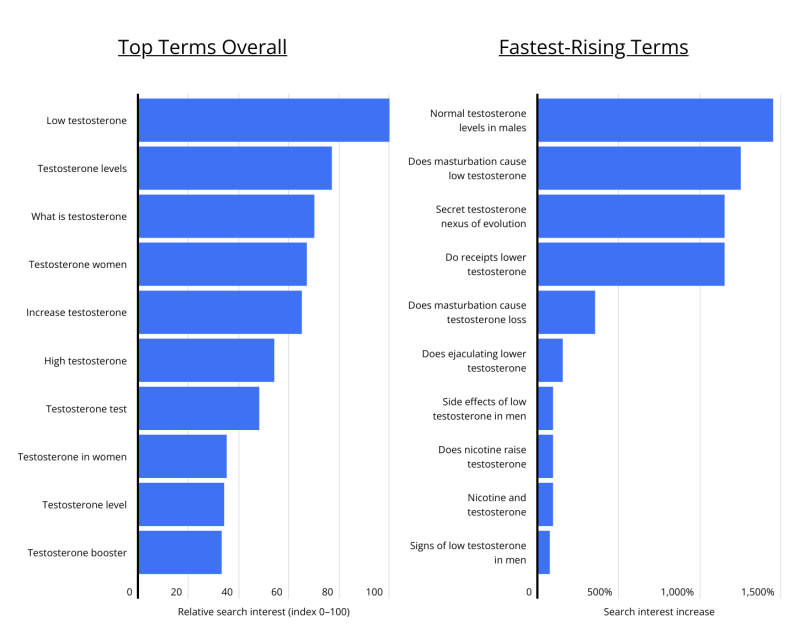
Google search data shows that Americans are seeking answers to a wide range of testosterone-related questions—especially related to symptoms, causes, and how the hormone functions in both men and women.
Over the past year, the most searched term by far was “low testosterone,” followed by related queries such as “testosterone levels,” “what is testosterone,” and “testosterone women.” Interest in how to “increase testosterone” also ranked highly, suggesting a strong public focus on diagnosis, treatment, and hormone optimization. Notably, there was considerable interest in how testosterone affects women, with terms like “testosterone women” and “testosterone in women” both appearing in the top 10.
The fastest-rising searches highlight a mix of practical health concerns and viral curiosity. Searches like “normal testosterone levels in males” (+1,450%) and “side effects of low testosterone in men” (+90%) reflect a desire for medically grounded information. At the same time, highly searched questions such as “does masturbation cause low testosterone” (+1,250%) and “do receipts lower testosterone” (+1,150%) reflect the influence of online health myths and social media speculation. One of the more unusual breakout terms—“secret testosterone nexus of evolution” (+1,150%)—likely refers to an online guide by the same name.
Together, these searches reflect a blend of medically grounded questions—such as those about hormone levels and symptoms—and more speculative or unverified claims that have gained traction through social media, podcasts, and other online wellness content.
Revitalize your health with Invigor Medical’s personalized Sermorelin therapy—secure telehealth evaluation, FDA‑registered compounding, and all-injection support delivered to your door. Enhance energy, sleep, muscle tone, and anti-aging benefits. Don’t wait—buy Sermorelin injections today for trusted, transformative wellness.

Which States Are Most Interested in Testosterone?
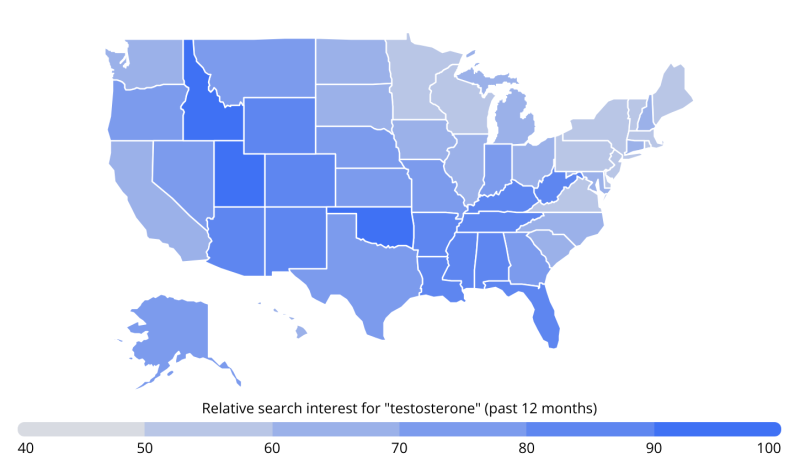
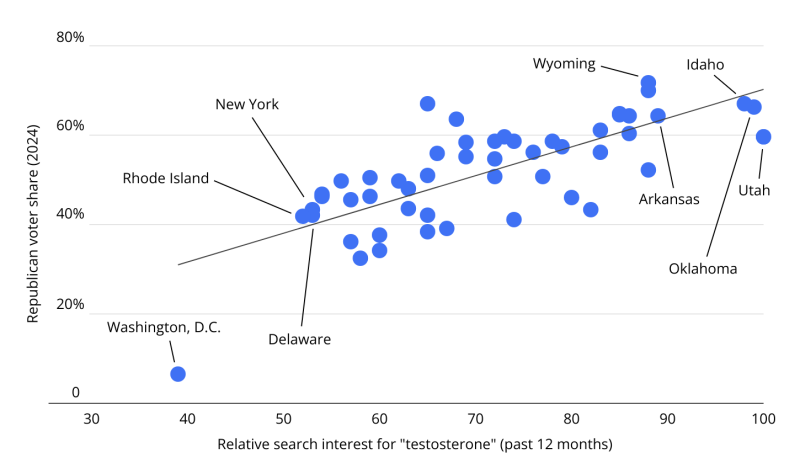
Despite a national uptick in interest around testosterone, search activity is not evenly distributed—it’s heavily concentrated in the South, Mountain West, and Appalachia. States like Utah, Oklahoma, Idaho, Arkansas, and Wyoming top the list for testosterone-related search interest. Others with high interest include West Virginia, Arizona, Tennessee, and Louisiana, reflecting a clear regional pattern.
Interestingly, many of these high-ranking states also lean strongly Republican. For example, each of the top five states voted at least 59% Republican in the 2024 presidential election. At the opposite end of the spectrum, states with the lowest testosterone search interest include Washington, D.C., Rhode Island, Delaware, and New York—all of which had some of the lowest Republican vote shares. In fact, the correlation between testosterone search activity and Republican voter share is strong (r = 0.74), suggesting that political leanings are intertwined with the topic.
Reignite your intimacy with Invigor Medical’s Trimix. Fast-acting, customizable injections deliver reliable performance when you need it most. Physician-prescribed, discreetly shipped, and supported by expert care. Take control of your confidence—buy trimix online today.
Testosterone Search Interest Compared to Republican Voter Share
There are several possible explanations behind this trend. In many conservative-leaning areas, there has been a renewed emphasis on traditional masculinity, strength, and vitality—values often promoted by fitness influencers, podcasters, and online wellness brands. Testosterone is frequently marketed as a tool for enhancing muscle mass, energy, libido, and overall male performance, which may resonate more in regions where these ideals are culturally reinforced. Additionally, the growth of telemedicine and direct-to-consumer health platforms has made testosterone treatments more accessible in rural and suburban markets, where healthcare options are sometimes limited and more residents seek out health information online.
Despite these regional and political differences, not a single state—including D.C.—has seen a decline in testosterone-related internet searches over the past decade. Across all states, interest in testosterone is clearly on the rise.
Below is a detailed breakdown of testosterone-related search statistics by state. For more information on how this data was collected and analyzed, see the methodology section.
Full Results
Methodology
This analysis draws on data from Google Trends, a public tool that measures the relative popularity of search terms over time and across geographic regions. Rather than reporting absolute search volumes, Google Trends assigns a normalized score between 0 and 100. A score of 100 represents the peak popularity of a term in a specific region during a selected time frame, while lower scores reflect proportionally lower levels of interest. These scores are relative to the total number of Google searches in that region, allowing for comparisons across states regardless of population size.
To identify where interest in testosterone-related topics is highest, the research team examined state-level Google search interest in the term “testosterone” over the 12-month period from July 9, 2024, to July 9, 2025. The resulting data was used to rank all 50 U.S. states by their relative search interest during this time. To highlight long-term changes in interest, the analysis also included a comparison of search interest from July 1, 2015, to July 1, 2025, measuring the 10-year change in search volume. In addition, the study identified the fastest-rising related search terms over the past year for each state.